

The Battle
Winter’s battalions marched in
upon our lands with their tempest-steeds,
and with icy swords, they plundered
every tree, flower, shrub, and field.
In their wake, only a ravaged landscape remained,
frozen, skeletal trees,
and dead, pale pastures.
Slowly, they surrounded our houses,
harassing us day and night.
The icy neighing of their horses
whistled through the cracks,
rattling our windows, battering our doors.
Around our homes, they set frosty thorns
as traps upon the gutters...
and the white army would not yield,
refusing to retreat.
Our stoves, in heavy iron armour,
rose up against them,
with revolutionary fire in their hearts,
to hold back the winter legions with their warmth.

We, too, donned our armour:
coats, hats, and scarves,
and thus fortified, we hauled the munitions
to the mouths of the stoves.
But the wood was already running low...
In the forest, the plight was worse than in the towns...
The weakest, the most defenceless were lost...
No flowers anywhere; none among them survived
Our life-force was fading...
We shivered, we coughed,
and the suffocating hands of confinement
choked the breath of optimism from within us.
All seemed lost.
But then... from the distance,
a great clamour was heard, with a familiar battle cry...
It was Spring. The General of Life,
leading his entire relief army.

All through February they battled,
and on a March Day, they claimed victory.
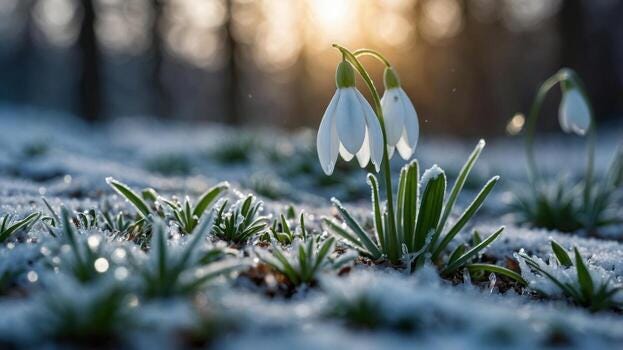
The bravest flower, the snowdrop, was the herald,
who, disguised in snow-white, scouted
from his deep-dug bunker,
bringing word of the liberating forces...
The blood of winter trickled from the eaves,
from the trees and bushes,
slowly soaked up by the earth,
while winter’s weary, stilled horses scattered away.
© Erika Csiszar. All rights reserved.
If you enjoyed this piece, a like helps it reach more readers. To read more, please subscribe!
Support my writing
Hungarian version
A csata
A tél csapatai bevonultak
fergeteg lovaikkal földjeinkre, s
jeges kardjaikkal feldúltak
minden fát, virágot, bokrot és mezőt.
Utánuk csak letarolt táj, s
megdermedt csontváz fák maradtak,
s halott, sápadt legelők.
Lassan körbevették házainkat,
s éjjel, nappal bennünket zargattak.
Lovaik jeges nyihogása
átsüvített a réseken, s
zörgették ablakainkat,
verték az ajtókat.
Otthonaink köré fagyos tüskéket
tapasztottak csapdaként a
csatornákra…
s a fehér sereg nem adott alább,
nem volt hajlandó
visszavonulásra.
Kályháink nehéz
vas páncélzatukban
felkeltek ellenük,
szívükben forradalmi tűzzel,
hogy visszatartsák a tél seregeit
melegségükkel.
Ránk is páncél került,
bunda, sapka, sál,
s felvértezve,
a muníciót hordtuk sorra
a kályhák elébe.

De a fa is fogyóban volt már…
Az erdőben a helyzet rosszabbá
vált, mint a településeken…
A gyengébbek,
a legvédtelenebbek oda lettek…
Virág sehol.
Közülük senki nem élte túl.
Életerőnk  fogyóban volt...
Fáztunk, köhögtünk,
s a bezártság fojtogató kezei
derűlátásunk légvételeit
kiszorították belőlünk.
Minden elveszni látszott.
De akkor…a távolból
egy nagy zsivaly hallatszott,
ismerős csatakiáltással…
Tavasz volt az. Az élet hadvezére,
s vele az egész felmentőserege.
Egész februárban csatáztak,
és egy márciusi napon
győzelmet arattak.
A legbátrabb virág,
hóvirág volt a hírnök, ki
hószínbe álcázva magát kémlelt ki a
mélybe ásott bunkeréből,
hírt adva a felszabadító erőkről.…
A tél vére lecsurgott az ereszeken,
a fákon, bokrokon,
s lassan beszívta a föld,
s elfáradt, elcsitult lovai szétszéledtek.
© Erika Csiszar. All rights reserved.
Ha tetszett az írás, egy kedveléssel segítesz, hogy másokhoz is eljusson. Ha szívesen olvasnál még, iratkozz fel!
🤩🤩